|
Eager Space | Videos by Alpha | Videos by Date | All Video Text | Support | Community | About |
|---|

LDEF framework crater analysis
https://sci-hub.se/https://www.sciencedirect.com/science/article/abs/pii/027311779390571R
Orbital debris database
https://orbitaldebris.jsc.nasa.gov/library/HOOSF_16e.pdf
Zerua orbitalal simulator
https://www.zerua.space/

Welcome to Eager Space...
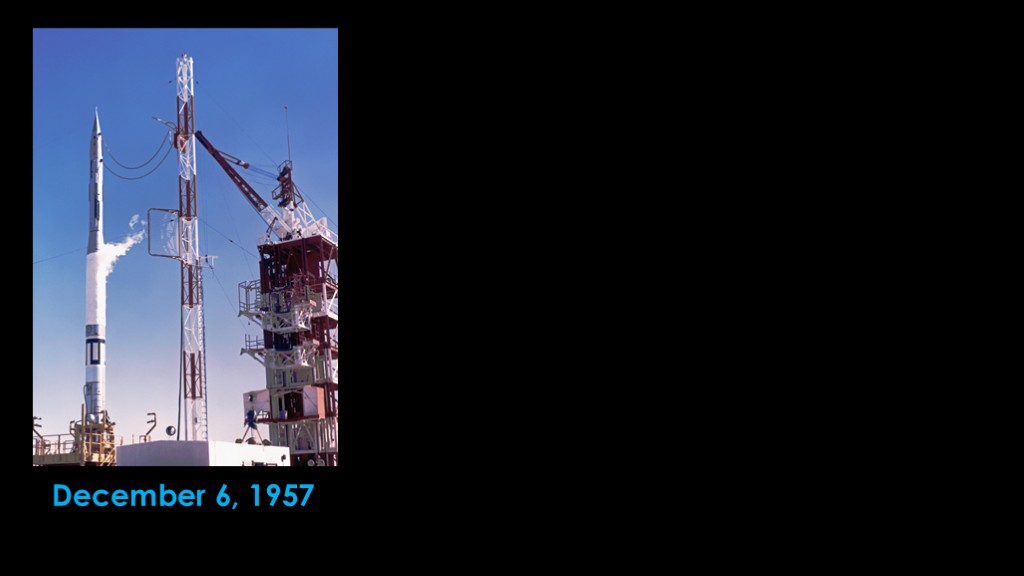
On December 6th, 1957, a Vanguard TV-3 rocket sat ready for launch. It would place the first US satellite in orbit as a response to the Soviet Sputniks 1 and 2.
At 11:45 eastern time, the three stage rocket ignited, majestically climbed 4 feet into the air, and then fell back to the pad.
Explorer 1 would become the first US satellite in orbit when it was launched in January of 1958.
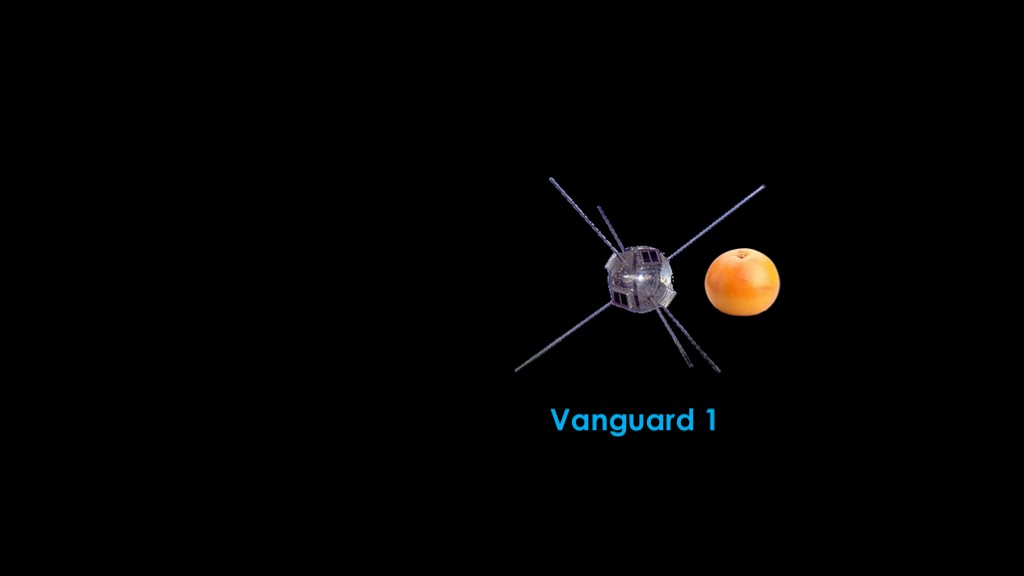
The vanguard satellite was a tiny thing, 6 inches in diameter and weighing a little over 3 pounds. It was roughly the size of a large grapefruit.
It was launched in March of 1958 on an upgraded Vanguard rocket. Once in orbit, it became the first solar powered satellite.
It also gained a more dubious distinction.
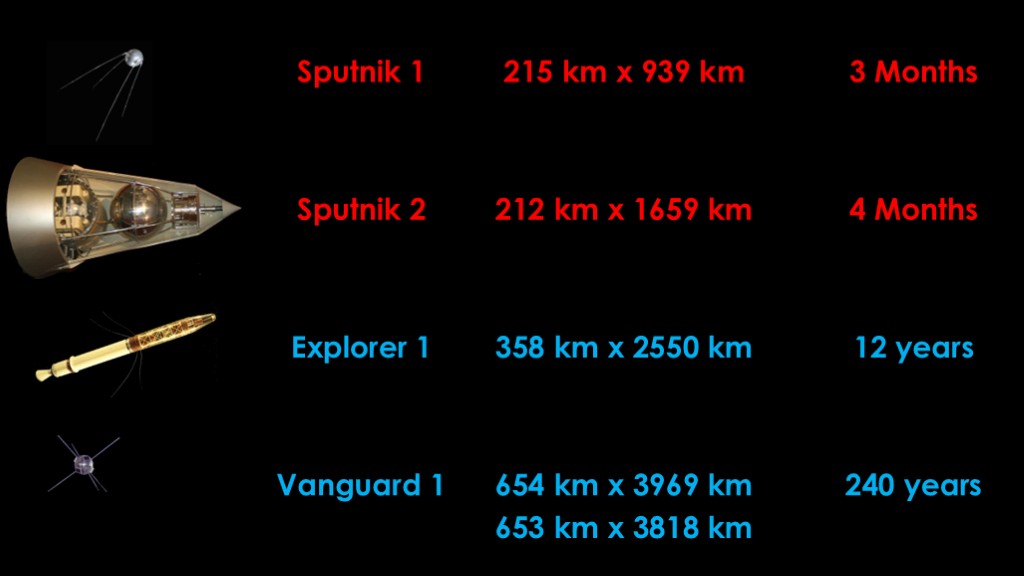
The two Sputniks had been launched into elliptical orbits with a perigee - or lowest altitude - of a little over 200 kilometers. That resulted in quite a bit of atmospheric drag and they reentered in a few months.
Explorer 1 had a slightly higher orbit, and though it only functioned for 3 months, it would stay in orbit for 12 years. It was therefore the first derelict satellite.
Vanguard 1 upped the ante, launching into a very high 654 by 3969 kilometer orbit. In the 68 years since the launch, it has decayed into a 653 by 3818 kilometer orbit, and a conservative estimate of its orbital lifetime is 240 years.
It is therefore the first orbital debris gift to future generations, and it was joined by the much larger Vanguard 2 and Vanguard 3.
It's therefore fair to say that the US started the orbital debris problem...
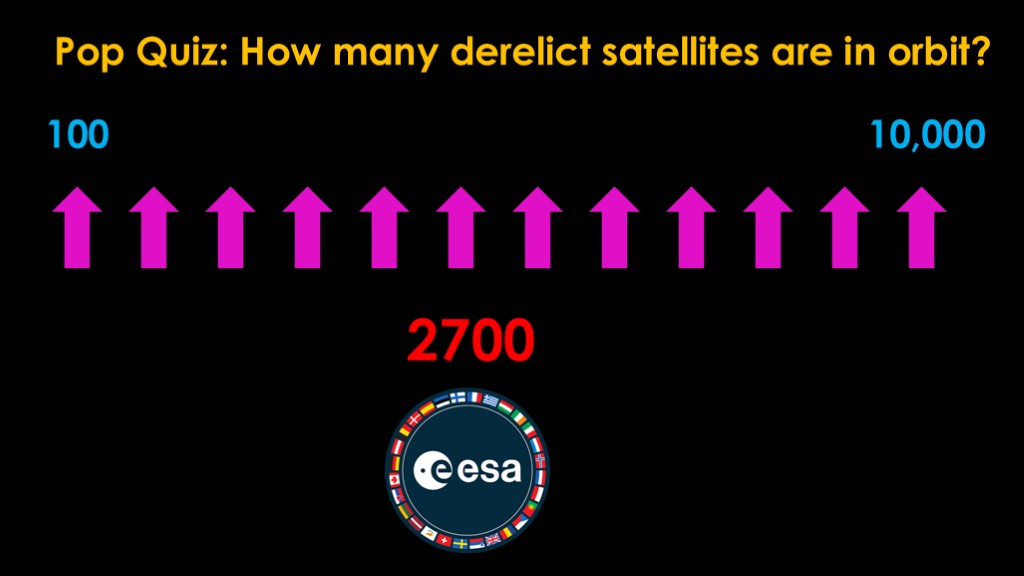
Let's start with a pop quiz. How many derelict satellites do your think are in orbit?
I'll give you a range. It might be 100, it might be 10000, or it might be somewhere in between.
Do you have a guess?
According to the European Space Agency's Space Debris group, there are currently about 2700 derelict satellites in orbit.
Is that a lot? Historically it was pretty close to the number of active satellites, but with the rise of starlink there are roughly 14000 active satellites.
That number doesn't seem that big, but - as we saw with the collision of Cosmos 2251 and Iridium 33 - it can still be problematic.
What can be done to reduce the collision potential of satellites that have finished their missions?
January 2026, ESA
https://sdup.esoc.esa.int/discosweb/statistics/
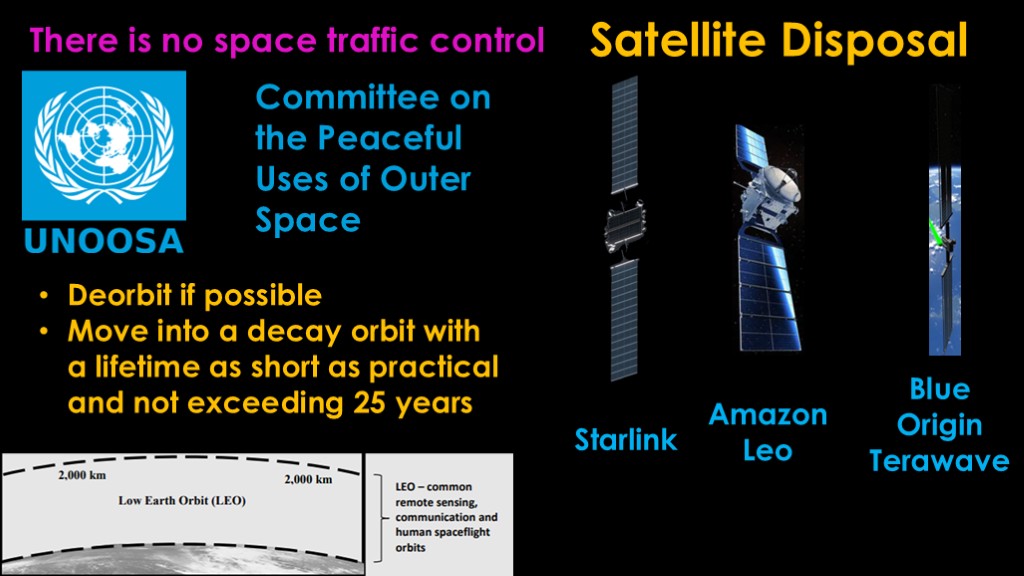
We'll start with low earth orbit satellites, with orbits all the way up to 2000 kilometers.
You'll remember that I said in a past video that there is no space traffic control, and this applies to disposal as well.
There is the united nations office for outer space affairs which contains the committee on the peaceful uses of outer space. Their current guidelines suggest deorbiting your LEO satellite if possible but if not, move it into an orbit that will decay with a maximum lifetime of 25 years.
In the US, the FAA looked at the rise of constellations and decided that the 25 year limit was too long, and in 2022 they reduced that to 5 years. That is short enough that some constellations will need to do active deorbit for satellites that have finished their mission.
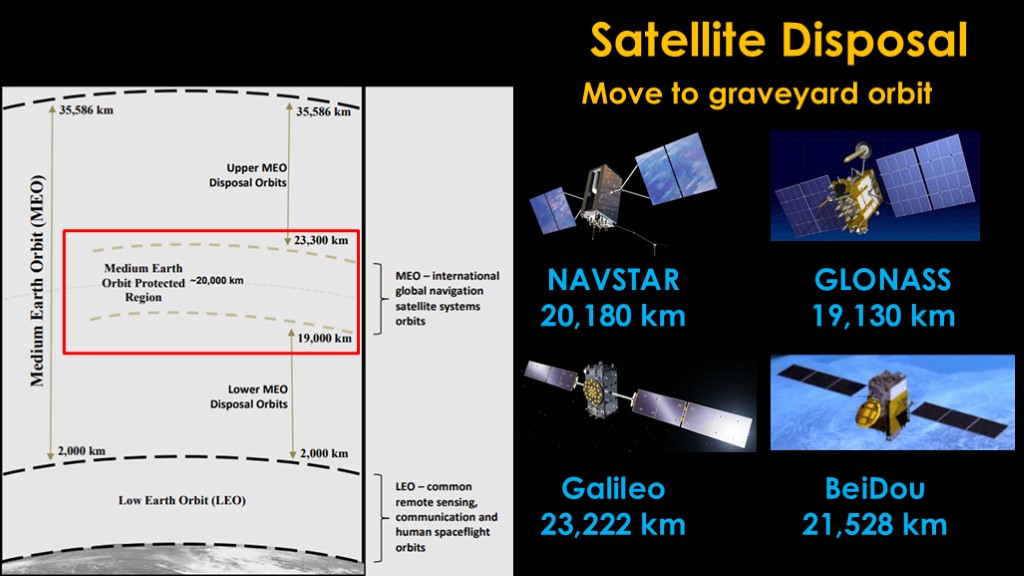
Moving up to medium earth orbit, the rules change. There is a protected region between 19000 and 23,300 kilometers for global positioning satellites.
The Russian GLONASS system lives at 19,130 km, the US NAVSTAR system lives at 20,180 kilometers, the Chinese BeiDou (bay dough) system lives at 21,528 kilometers, and the European Galileo system lives at 23,222 kilometers.
In this protected region, retired satellites can either be left in those orbits - as there are no other users at each orbit - or they can be moved up or down to graveyard orbits.
Operators could choose to change the trajectory of their satellites so they would decay and reenter, but that would take a considerable amount of propellant and satellites in this orbit generally aren't a problem.
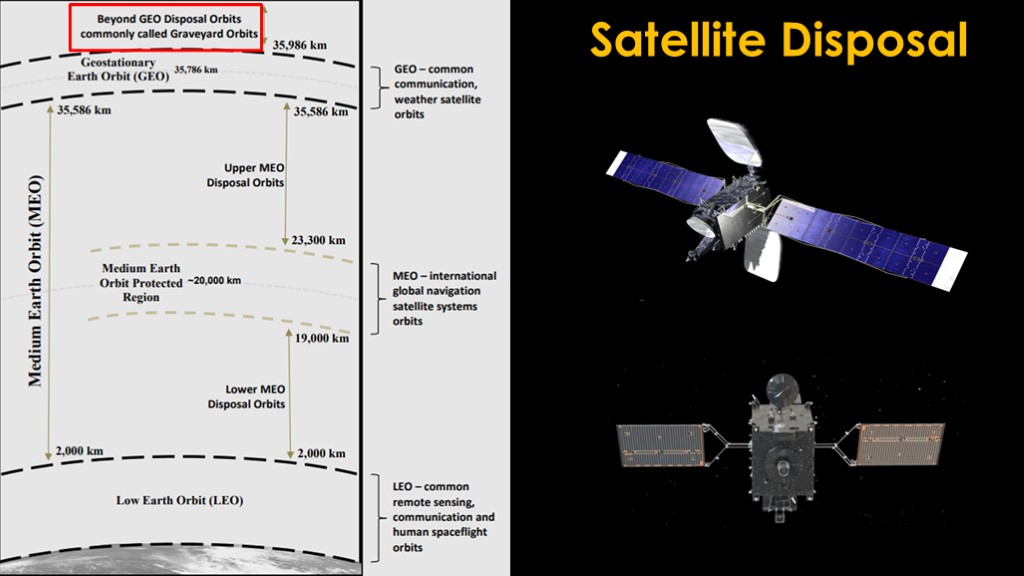
And finally, we get to geostationary orbit. The energy cost to deorbit these satellites would be huge, so the recommendations are that the satellites move into a higher graveyard orbit that will be at least 230 kilometers higher than geostationary orbit.
That orbit is slightly slower than the geostationary orbit so the retired satellites can wave to their still-active friends as they go by and also chat with the military satellites in that higher orbit.
Disposal seems fairly straightforward for medium earth orbit and geostationary orbit, and - with the 5 year LEO limit in the US - that seems fairly manageable.
But things are rarely that simple.
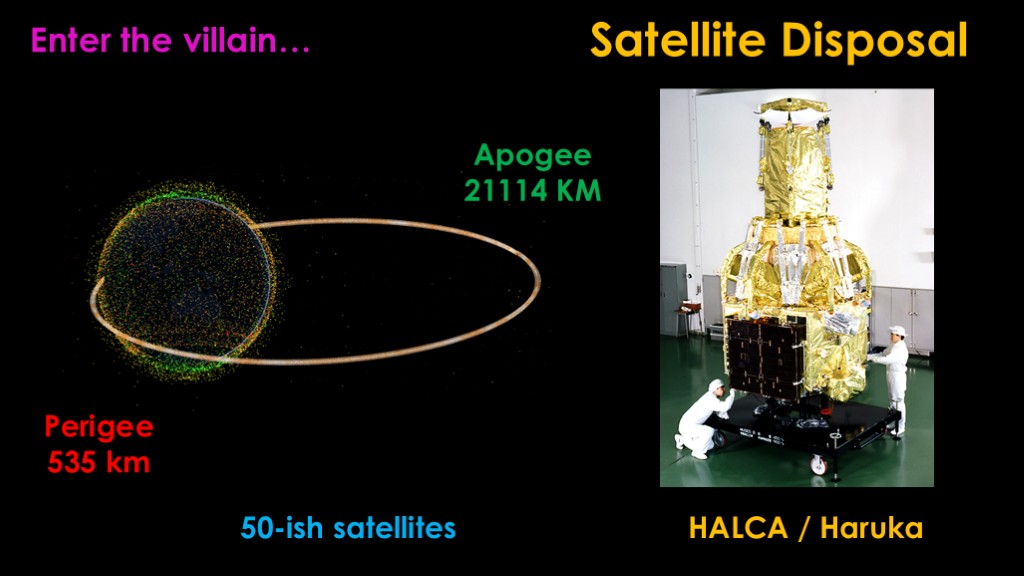
This is HALCA / Haruka, a research radio telescope launched by Japan in 1997, and retired in 2005.
The apogee of halca is all the way out around 21,000 kilometers. The perigee is down at 535 kilometers. About 3 times a day it dives down through the medium earth orbits and dips into the meat of low earth orbit, losing a little bit of energy each trip.
There are roughly 50 satellites in orbits like this, and it will be many decades before they decay.
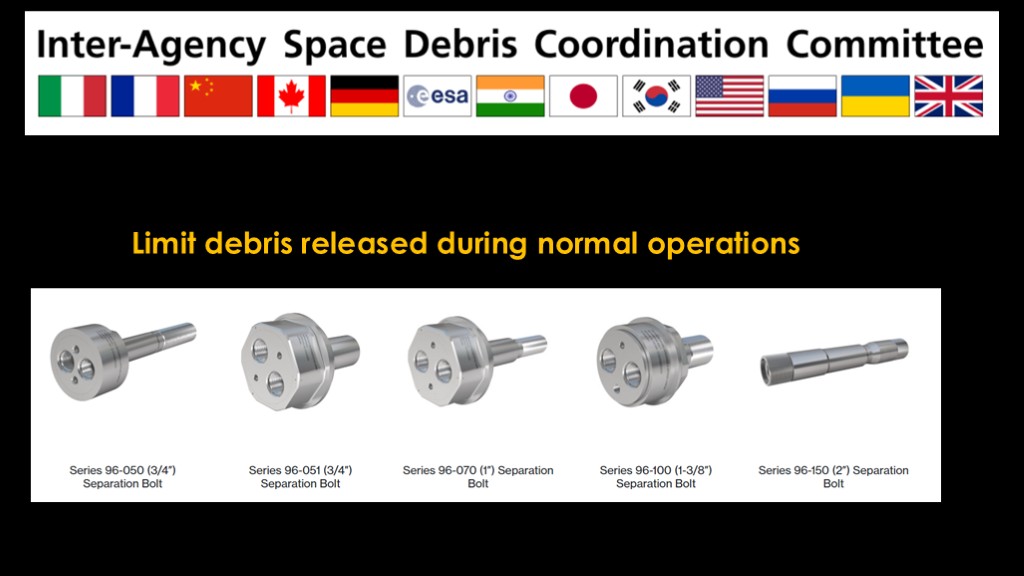
The UN inter-agency space debris coordination committee has released some guidelines on the reduction of orbital debris from satellites.
The first is to limit debris released during normal operations.
It is common for spacecraft to use separation bolts to detach from the launch vehicle or to release solar panels. These bolts either use pneumatic or explosive methods to fracture them, and in the past, these bolts became space debris. The guidelines suggests keeping those parts from floating away from the spacecraft.
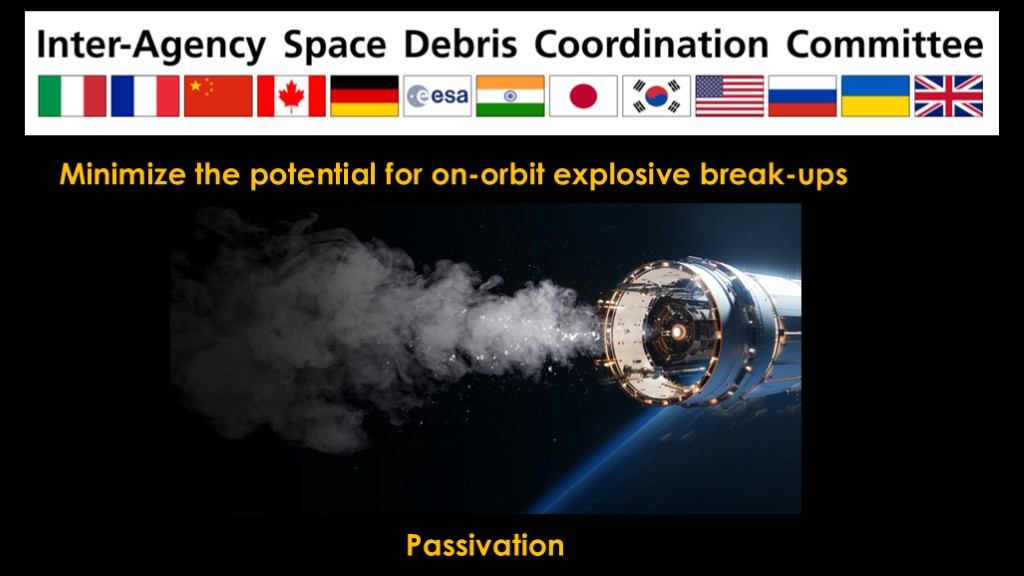
The second is to minimize the potential for on-orbit explosive break ups.
This is all about reducing the amount of stored potential energy in the spacecraft through a process known as passivation.
That means depletion burns or venting of propellants, venting of high pressure vessels, and discharge of batteries. Also stopping flywheels or momentum wheels or at least removing their power.
It's also recommended that intentional destructions should not be planned or conducted.
Passivation has definitely reduced the amount of orbital debris that is created - satellites are much more likely to stay together.
But the big problem isn't satellites, it's the rockets that launched the satellites.
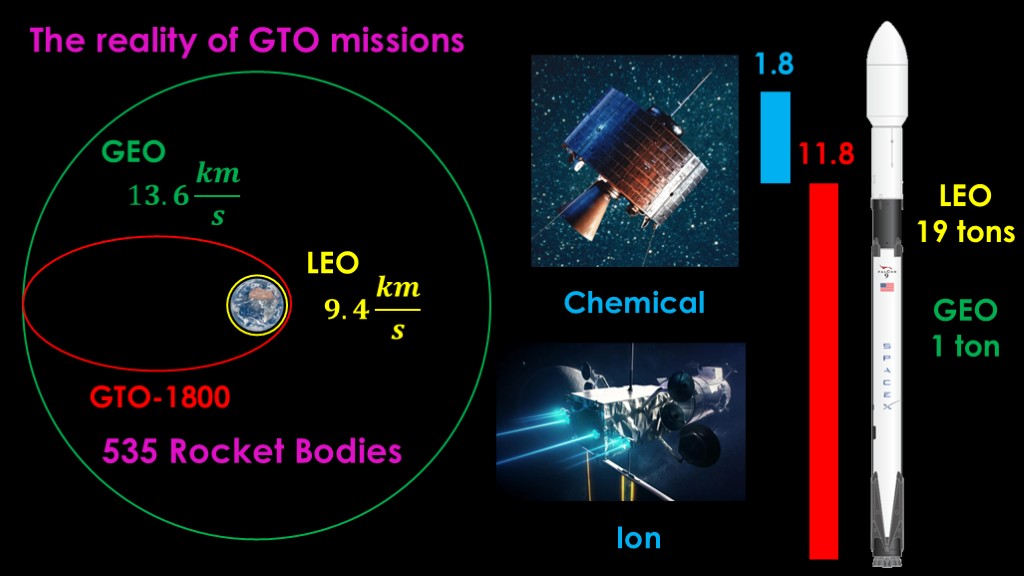
It's tough to get to Geostationary orbit.
To get to low earth orbit takes about 9.4 kilometers per second of delta v, and that can be easily done with a two stage rocket.
But to get out to geostationary orbit at over 36,000 kilometers takes a lot of delta v - if you are launching from Florida it takes a total of about 13.6 kilometers per second of delta v.
The Falcon 9 can do about 19 tons to low earth orbit. If you want it to take your payload all the way to geostationary orbit, it will have a payload in the range of 1 ton.
The payload is so low because you need to haul the whole second stage out to the final orbit, and second stages use chemical engines with relatively low specific impulses, so it's not fuel efficient.
The solution is to add a third stage to the launch system, and that is normally done by adding an engine to the satellite. In the early days, it was a chemical thruster using the same hypergolic propellants that the satellite would use to stay in position, but in recent years satellites have switched over to using ion thrusters powered by electricity as they are much more fuel efficient.
The launch vehicle will put the satellite into a highly elliptical geosynchronous transfer orbit, with a perigee or low point of 200-500 kilometers and an apogee or high point of either the geostationary altitude at 36,000 kilometers or even beyond that.
The benchmark for these orbits is GTO-1800, which means the launch vehicle will generate around 11.8 kilometers per second of delta v, and the satellite will generate the remaining 1.8 kilometers per second of delta v to get to the target geostationary orbit.
Which leaves the second stage - what the orbital debris folks call the "rocket body" - in that very elliptical transfer orbit. And there are 535 of rocket bodies in these orbits, more than an order of magnitude than satellites.
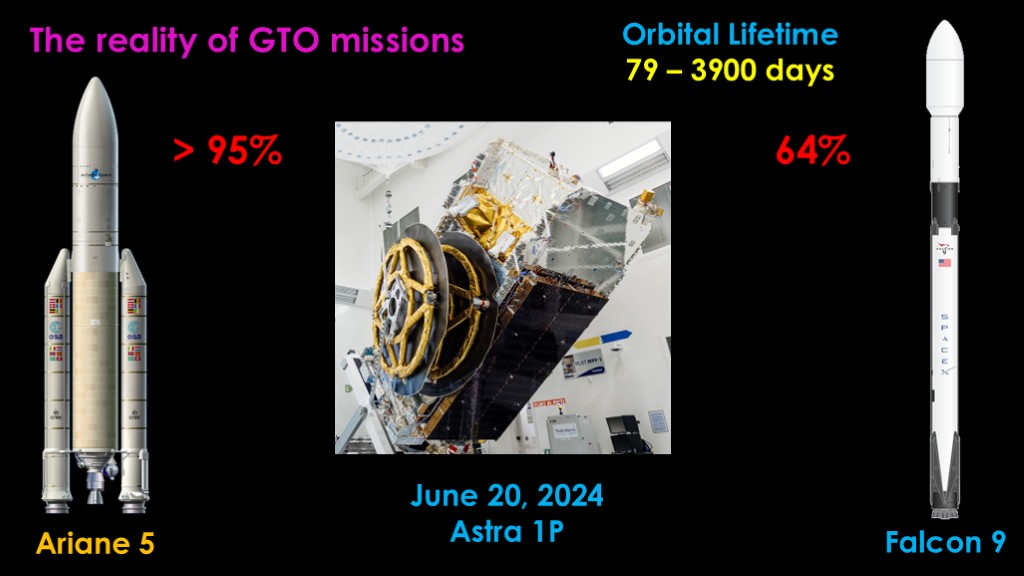
Ariane 5 is the most successful launcher to geostationary orbits, with more than 100 missions to GTO. More than 95% of the second stages from those launches are still in orbit, and many of them are over 25 years old.
Falcon 9 has done a bit better - it has launched 66 GTO payloads and only 64% of the second stages are still in orbit. The orbital lifetime of those that reentered varied from a low of 79 days to over 3900 days for one of the first payloads, with 300 days being pretty common. That's certainly an improvement over the Ariane 5 lifetime, but even a year is a long time, and there are some that are over 10 years old and are not coming down any time soon.
But when I looked at the data, I found something unexpected. On June 20th, 2024, Falcon 9 launched the 5000 kilogram Astra 1P satellite to a geosynchronous transfer orbit, but there is no record in space track of the rocket body. The only explanation is that it deorbited before it was added to the tracked list, which takes roughly a day to happen.
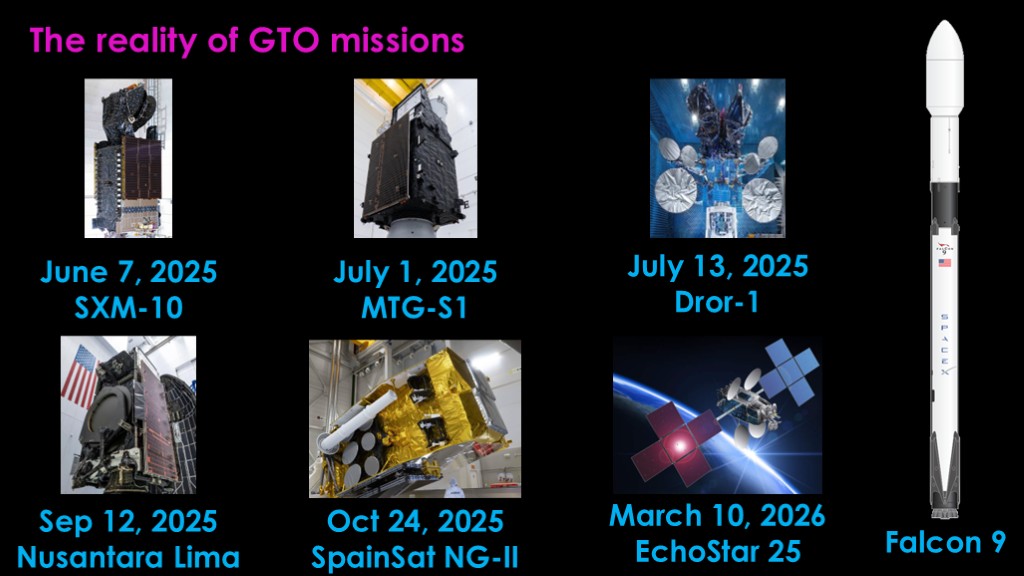
And on June 7th, 2025, it happened again. Falcon 9 launched the 6400 kilogram SXM-10 satellite into geosynchronous transfer orbit without leaving the second stage in orbit.
Since then, all 5 Falcon 9 launches to GTO have resulted in an untracked rocket body because of quick reentry. Though to be precise, the second stage for the Dror-1 launch was a tracked object for a single day before it reentered.
I believe SpaceX is doing this by reserving enough propellant to move the second stage from the initial geosynchronous transfer orbit to one that will intersect with the earth and therefore deorbit very quickly.
This is a very nice change and I hope that Ariane 6 will adopt that approach when it begins launching satellites to GTO.
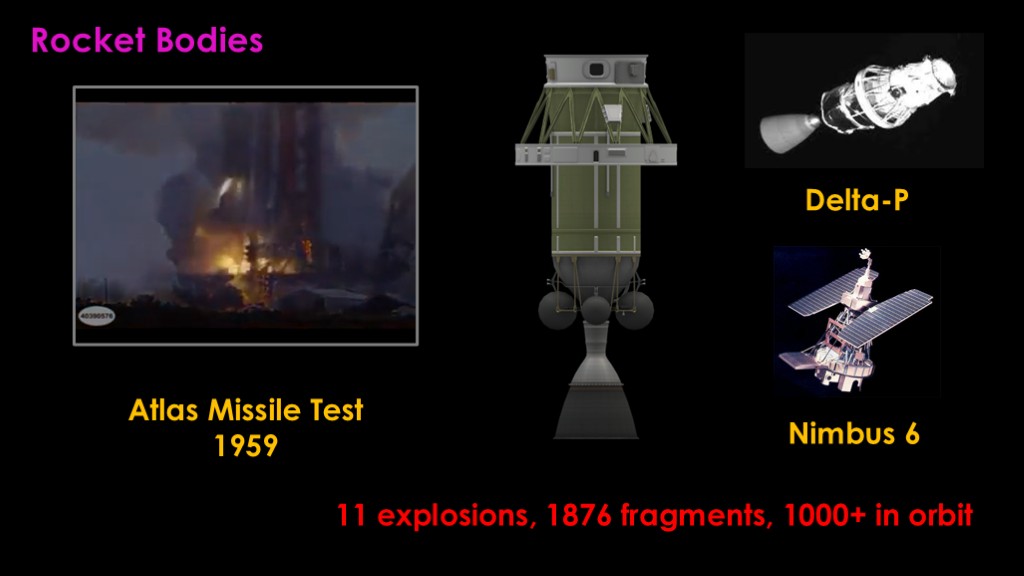
But is the rocket body problem really so bad?
The answer is yes.
We all know that it isn't uncommon for rockets to blow up on launch.
What is less well known is that rockets sometimes blow up *after* they get into orbit.
This is a delta-p upper stage for a delta rocket. One like it launched a Nimbus 6 weather satellite in 1975. The second stage calmly orbited the earth for 5802 days - nearly 16 years - at which point something happened and it exploded into 308 trackable fragments, presumably from a fault in the propulsion system that used highly reactive hypergolic propellants.
Delta second stages blew up 11 times, generating 1876 tracked fragments, with over 1000 still in orbit. And note that these are tracked fragments - explosion events generate more fragments that are too small to be tracked.
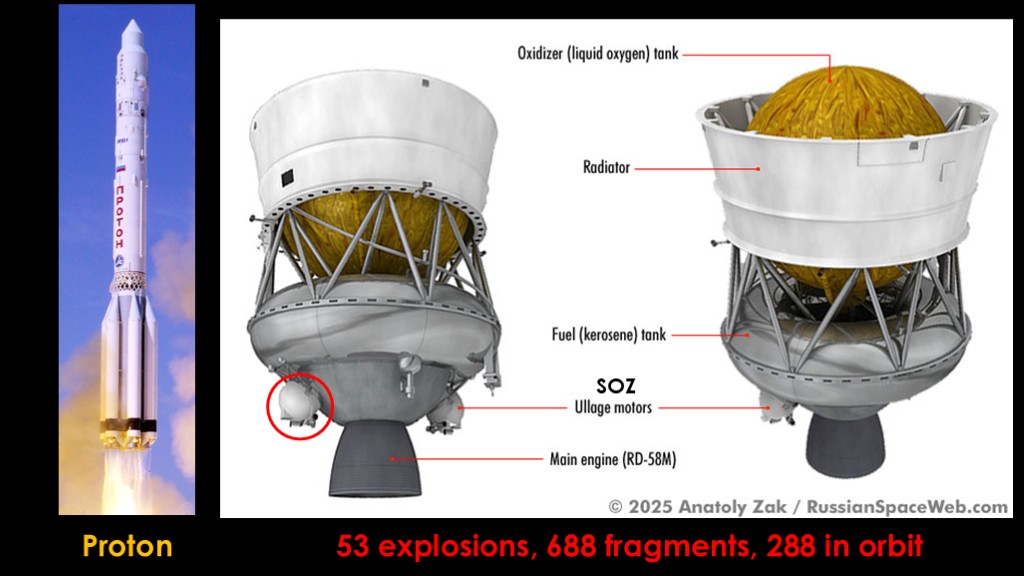
This is the Russian Proton rocket.
The upper stage has small "SOZ" ullage motors that are used to maneuver and to settle the propellant in the tanks before the main engine starts.
At least that is their primary purpose. Their secondary purpose seems to be to explode
They have exploded 53 times over the years, but they are underachievers compared to delta, generating only 688 fragments with 288 left in orbit. They do, however, have a long shelf life - some have exploded more than 20 years after the launch. There are still over 60 of these upper stages in orbit.
Like the delta upper stage, they use hypergolic fuels, and that is likely the cause of the issues.
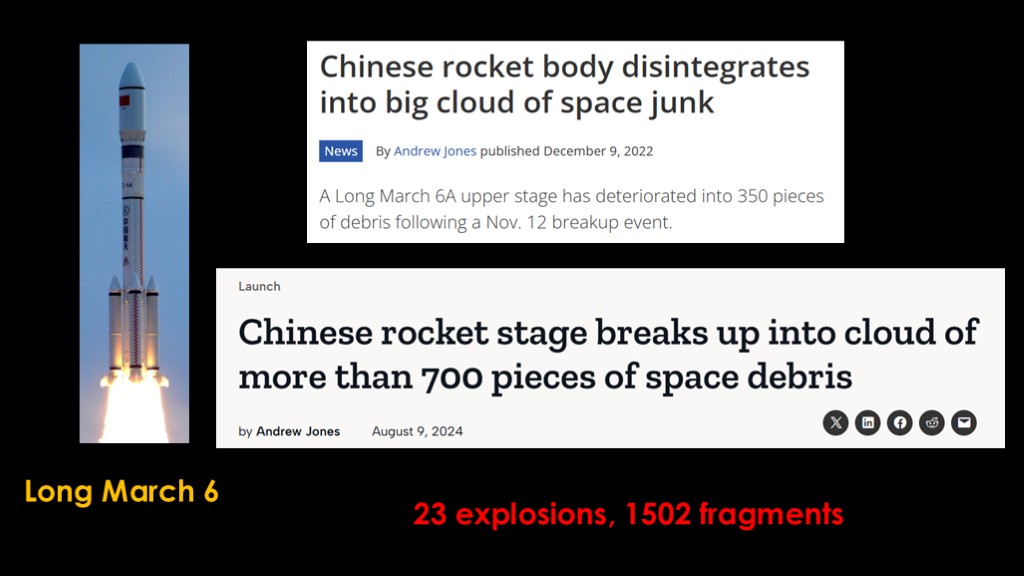
China has had issues with their Long March 6 series of rockets, generating 23 explosions and 1502 tracked fragments. And these are in the last few years, when most operators are more careful to avoid this.
There is one big difference between satellites and rocket bodies.
Satellites are designed with reliability in mind, and that means their systems are more robust. They do explode now and them, but the goal is for them to have active missions that last for many years.
The missions of rocket upper stages end as soon as the satellite is released, and that means that explosions have no effect on mission success - they just pollute space.
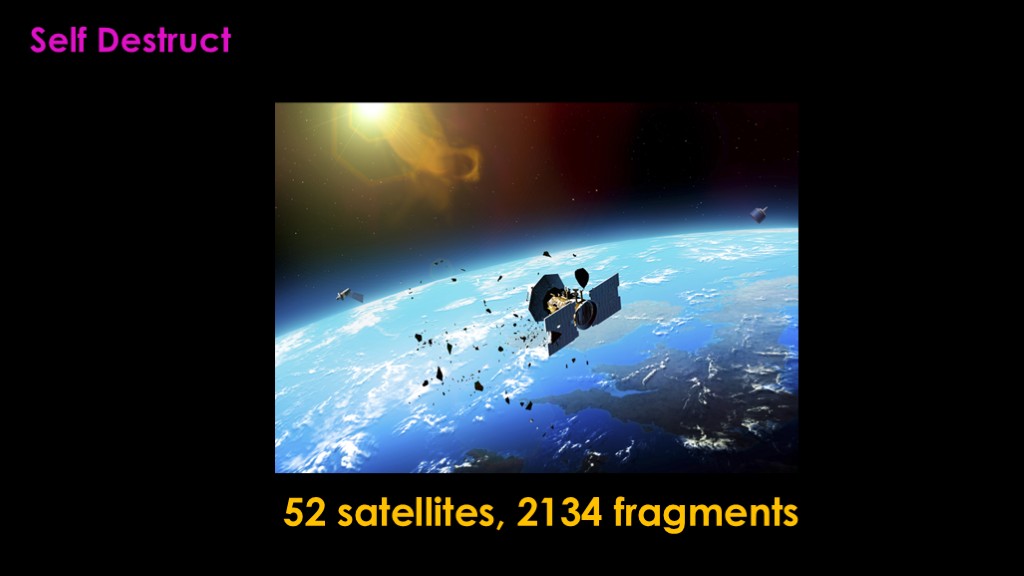
When I first looked at NASA's list of debris generating events, I was surprised to find two words. Those words were "Self destruct".
The soviets did that on 52 satellites, generating 2134 tracked fragments. You might think that is an antisocial thing to do, and you would be right.
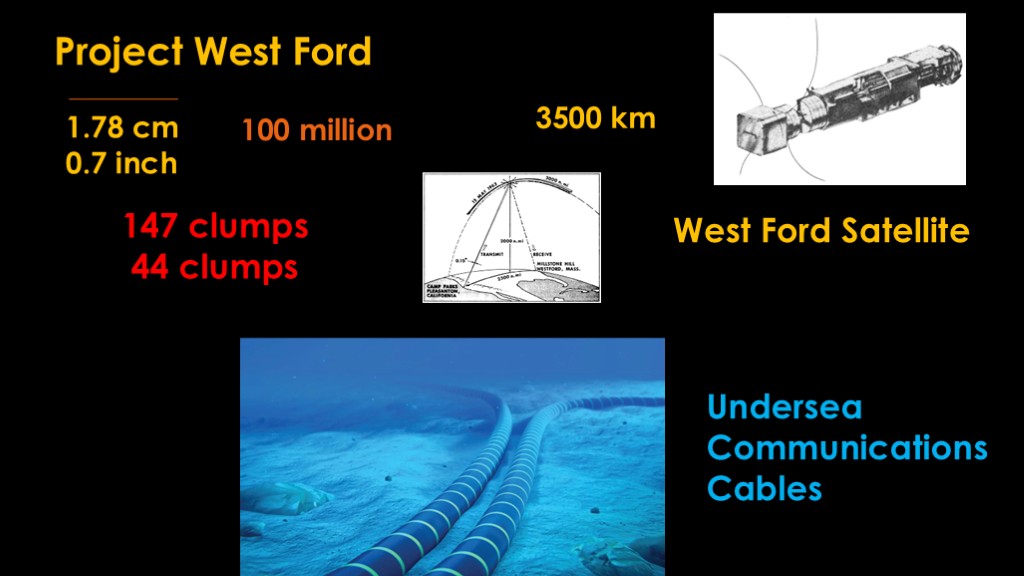
But this discussion wouldn't be complete with a mention of project west ford.
Back in the early 1960s, the US was worried that the soviet union might cut the transatlantic communications cables that kept the US and its European allies in contact.
They therefore they came up with an idea.
Make a bunch of short copper needles, and by a "bunch", I mean hundreds of millions. Then put them into a satellite, launch then into high orbit, and use them as radio reflectors, solving your problem.
The concept worked, successfully bouncing radio signals from the California to Massachusets
You might think that this is a horrible idea from a debris perspective, but analysis showed that the individual needles wouldn't last more than a few years in orbit.
Unfortunately, it turns out the many of the needles clumped up rather than dispersing, and there were 147 chunks big enough to be tracked by the US tracking system, and there are over 40 tracked clumps remaining in orbit in 2026. There are also an unknown number of smaller clumps.

How do we deal with derelicts?
I will talk about proposed solutions in a later video, but none of them are operational.
Right now, the focus is on not making the problem worse, and that means early deorbiting and passivation.
And that's all for part 3. Thanks for watching.

There was only one possible song for this video.
It's Tripod's "Ghost Ship" off their 2004 live album Fegh Maha.
https://www.youtube.com/watch?v=5LifUtvruW8